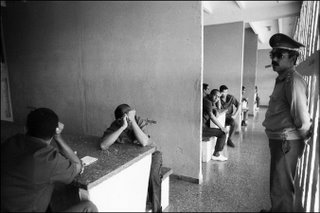
Sunday, July 8, 2012

FORMER ARGENTINE DICTATORS FOUND GUILTY OF BABY THEFTS

Reference: AFP Poster referred from Alternet

Two former Argentine dictators were handed heavy prison sentences for overseeing the systematic kidnapping of babies from leftist activists killed during the 1976-1983 dictatorship.

A common tactic of sibling warfare is to tell your brother he's adopted. It's funny and harmless because it is generally so far fetched, but for hundreds of Argentines that suggestion is no joke
From 1976 to 1983 an estimated 500 babies were stolen and secretly integrated and adopted into families of right-wing military members and their allies as part of a sweeping program that brutally targeted left-wing militants and sympathizers during the military junta’s seven-year rule.

Bringing, perhaps, a fragment of closure to that era, a former Argentine dictator, Jorge Videla, was convicted yesterday for his role in the program. Mr. Videla, who headed the coup that brought the military to power in 1976, was sentenced to 50 years in prison.

The conviction and official recognition of these crimes marks a historical moment for Argentina, whose public has long known of or suspected these practices and which continues to search for answers.
References: 
The Christian Science Monitor, "Former Argentine dictator Jorge Videla convicted   of systemic theft of babies."
AFP, "Tough sentences in Argentina stolen babies case" 

Saturday, June 2, 2012

ONE LESS DICTATOR

Unfortunately, there are many times in history in which dictators and tyrants get away with their crimes and are never brought to a court of law for genocide and repression against their own people.

Hopefully, history does not necessarily repeat itself as there are other circumstances in which those from bellow rise and initiate a resistance movement that leads to the toppling of dictatorships. This is the case of Mubarak in Egypt. His dictatorship was overturned by the movement that became known as the Arab Spring. A wave or resistance that started on 19 December, 2010 and forced from power rulers in Tunisia, Egypt, Libyia and Yemen with other civil protests and uprisings (varying in their intensity) in Bahrain, Syria, Algeria, Jordan, Kuwait, Morocco, Lebanon, Iraq, Mauritania, Oman, Saudi Arabia, Sudan and Western Africa.

Although totalitarianism continues to be a trend in today's world, the case can also be made that at no other time in human history the common person has had at his/her disposal the technological and other means to start a challenge power.

Former Egyptian dictator Hosni Mubarak (now 84 years old) sentenced to life in prison. During the protests in Egypt that led to the fall of the Mubarak regime, about 840 people died and more than 6,000 others were injured in the 18-day uprising in 2011 according to Amnesty International. Read full Story in CNN.
Reference:
, and , "The Arab Spring: an interactive timeline of Middle East protests" The Guardian (January 5, 2012).

Ben Wedeman, "Egypt's Hosni Mubarak sentenced to life in prison for role in killing of protesters." CNN  (June 2, 2012)

Tuesday, May 29, 2012

GRAFFITI: THE ART OF RESISTANCE IN CUBA

Cuban graffiti artist (a.k.a., 'El Sexto) draws graffiti all over his passport in protest for the Castro regime's violation of the freedom of movement. Cuba is only a among the few repressive nations worldwide in which a citizen needs a special permission from his own government to travel abroad. El Sexto has been detained and harassed for his graffiti by the National Revolutionary Police  (PNR) of Cuba and the State Security Police. For more graffiti art, visit the Blog: 'El Sexto


"I will keep drawing graffiti until I find out why I keep doing it.
I do so because I feel the need - as I need to walk, dream.
Never stop dreaming because you can also change things.
El Sexto is the Cuban people.
I am merely the one who draws the graffiti.
All the Cuban people are heroes: from the child who wakes up in the morning and does not have breakfast to eat until the worker who shows up for work despite his meager salary."
Blog: 'El Sexto
 

Wednesday, May 23, 2012

CHINA'S CHENGGUANG'S PARA-POLICE

The Chengguang or City Urban Administrative Law Enforcement Bureau was established in Beijing in 1997. It is a para-police agency in charge of enforcing non criminal urban administrative regulations. However, for the the Chinese people they have gained a reputation for excessive force and brutality. For some they are gang members, thugs in uniform who have gained a reputation for arbitrary behaviour and abuse. They allegedly enforce administrative laws but in their operations they are known to make illegal detentions, forceful confiscation of property, serious injury and even death. 

Multiple versions circulate around this photo. Some say it shows Chengguang police violently arresting a prostitute. The official version is that they are arresting a woman who tried to commit suicide. The reasonable doubt remains and readers can make their own conclusions. Source: China Hush
A photo of a what is seemingly suggested as a Chengguang squads attacking a police officer. Source: China Hush
Chengguang members in a street fight.Source: China Hush


For more information on the Chengguang, see a report by Human Rights Watch titled: "Beat Him, Take Everything Away" Abuses by China's Chengguang's Para-Police."

Wednesday, May 16, 2012

MEXICAN WRITER CARLOS FUENTES DIES

Carlos Fuentes, one of the most prolific Latin American writers associated with the Latin American Boom, a literary movement made up of young authors critical of the status quo and established traditions died at age 83 in a Mexico City hospital.

Candidate for the Nobel Prize, winner of the Cervantes Prize in 1987 among many other distinguished literary awards, Fuentes' wrote a wealth of novels, plays and essays as well as regularly commenting on political events in the Spanish newspaper El Pais. His most famous works were "The Death of Artemio Cruz" and "The Old Gringo."

On this day I would like to pay tribute to this important writer as he had the honesty and vision to compare populism in Latin America with Fascism. In particular I would like to recall his now historic words when Fuentes compared Hugo Chavez (the president of Venezuela) with Benito Mussolini:

Fuentes warned on 2007 that the Latin American hemisphere risks the emergence of governments that are not only populist but also fascists. Fuentes said this is the case with president "Chavez who rules a regime that in its organization, rhetoric, purposes, uniforms and balconies resembled a Venezuelan Benito Mussolini."
With all the gestures and political theater similar in all populist political system (either fascistic or socialist) this photo arrangement shows the choreographic aspects that has distinguished populism throughout history. The pop photo shows Benito Mussolini saluting followers from a balcony. The lower photo shows Hugo Chavez with a closed fist symbolic of Chavismo saluting followers from the presidential balcony) Photo arrangement/selection by Blog Salon de Talleyrand


For more information about 'populism' in the Latin American context I recommend "The Integralist Movement in Brazil"  

References:
"Mexican author Carlos Fuentes Dies at 83" BBC News (May 16, 2012)
"Escritor Mexicano Carlos Fuentes muere a los 83 años por problemas cardiacos" NTN24/EFE (15 de Mayo del 2012)
"Como Fascista Tipico" Salón del Señor Talleyrand
"Carlos Fuentes llama "perturbado" al presidente de Venezuela" Asociación Mexicana de Derecho a la Información (13 de Noviembre del 2007)


Tuesday, May 15, 2012

CUBA: A COUNTRY OF PLACARDS

"Revolution is to Change Everything that Needs to Be Changed"
"Mister Imperialists: We have absolutely no fear of you" Reference: TuAventura
"50th Anniversary of the Revolution's Triumph" Reference: Prensa de Frente
"We Work: What about you? (Not working in Cuba carries a criminal conviction. Currently there is a large percentage of the population who refuse to work for the state with average salaries of $25 dollars a month). Reference: Prensa de Frente
"We want them to be like Che" (in reference to pioneers) Reference: TuAventura
"Fatherland or Death" Reference: TuAventura
"Our Weapons: Conscience and Ideas" Reference: TuAventura


"We move forward victoriously" Reference: TuAventura


Cuba is a country of placards as long as they are pasted and sponsored by the government for purposes of propaganda. Pro democracy signs are immediately covered by the police and those responsible for their content could face long prison sentences if they are caught. This picture shows a police in Cuba covering a graffiti that reads "Down with  Fidel" Reference: Enrique de la Osa / EFE / El Nuevo Herald


Who posts placards in Cuba?
The Propaganda branch of the Cuban Communist Party 

What is their content? 
As any form of propaganda, it is based on repetition of the same phrases. In this sense they make the Nazi precept that a repeated lie becomes true come to life. Usually placards praise Fidel and Raúl Castro. The most repeated slogans are "United We Will Triumph" "Victory After Victory" "Our Main Duty is to Perfect Socialism."

What is their purpose?
Physiological influence over the people. To present an image to foreign visitors that in Cuba everyone shares a common "revolutionary fervor."It is also an excuse for political organizations to look well with their superiors. 

The above text is a translation taken from extracts of a larger article on placards in Cuba written by Eliecer Avila. For more information see Eliecer Avila, "El País de los Carteles" Diario de Cuba (15 de Mayo del 2012).


Sunday, May 13, 2012

ERITREA, THE MOST REPRESSIVE NATION ON EARTH

According with Reporters Without Borders, Human Rights Watch and other organizations that monitor human rights and freedoms worldwide, Eritrea, an extremely poor nation of the African continent in the neighborhood of Sudan, Ethiopia and Somalia is considered to be the most repressive nation on earth. A tough and in my view a controversial selection considering competitors in the repressive category such as North Korea, Cuba, Iran, Belarus and other nations. Under the regime of president Isaias Afewerki, 25% of  Eritrea's population has fled over the past 20 years. The Afewerki regime  has turned the nation into a "giant prison" according with Human Rights Watch with over 314 detention centers. Some of the country's prisons are underground, buried 229 feet bellow sea level with temperatures reported to reach 140 degrees Fahrenheit. In those prisons there are  thousands of journalists, religious leaders and dissidents imprisoned, detained indefinitely and subjected to medieval tortures that include their feet shackled, tied to a cross or hung upside down and other forms of cruelty. Image from Edmund Sanders / TPN


For a complete report on jailed journalists see: Justin D. Martin, "Which Countries Jail the Most Journalists Per Capita? Taking the CPJ  Data One Step Further" Columbia Journalism Review (April 2, 2012)
For more information on Eritrea see Joel Brinkley, "Eritrea, the most repressive nation on Earth" SFGate (April 29, 2012)

Friday, May 4, 2012

NORTH KOREA: TOTALITARIANS IN THE NUCLEAR CLUB

Photo from Ng Han Guan/Associated Press/NYTimes
North Korea is the last Stalinist state on earth, and in 2006 it became the latest country to join the nuclear club. Over the past two decades, it has swung between confrontation and inch-by-inch conciliation with South Korea, its neighbor, and the United States, in an oscillation that seems to be driven both by its hard-to-fathom internal political strains and by an apparent belief in brinksmanship as the most effective form of diplomacy.

See complete article in the NYTimes. 
See also 'NORTH OF TOTALITARIANISM' with a compilation of photos from North Korea

Wednesday, May 2, 2012

CUBA'S LARGEST PRISON

Cuba's Population: 11.3 millions.
Worldwide Ranking: Cuba has the fifth largest inmate population in the world with 531 prisoners for every 100,000 inhabitants. 
Latin American Ranking: Cuba is ranked as the second nation with the largest inmate population per inhabitants in Latin America and the Caribbean. 


Source Consulted:
For statistical information on the number of prisoners per inhabitants in Cuba and worldwide see Roy Walmsley, World Prison Population List, Eighth Edition (King College, London, December, 2009), 1 & 3. 

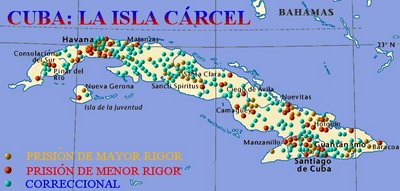
Cuba: The Prison Island
Map of Cuba's Prisons. Legend from top to bottom:
1. Maximum Security Prisons. (Yellow)
2. Minimum Security Prisons. (Red)
3. Correctional/Reform Prisons.(Blue)
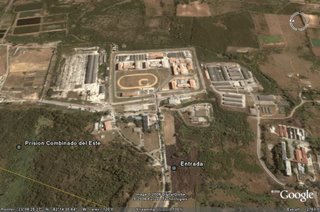
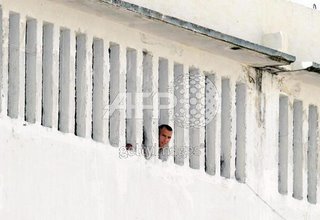
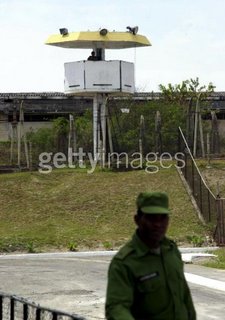
COMBINADO DEL ESTE PRISON
Cuba's Largest Prison
Built in 1975. 
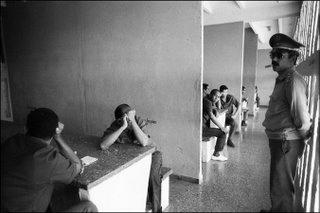
Hidden Camera inside El Combinado del Este Prison."En las Entrañas del Combinado del Este" by Dalvinder Singh Jagpal (inmate) and Dania Virgen García (independent journalist/reporter).


Aerial view of Combinado del Este
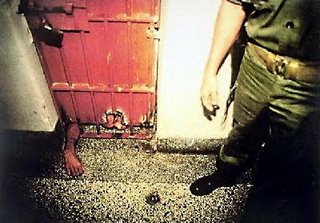
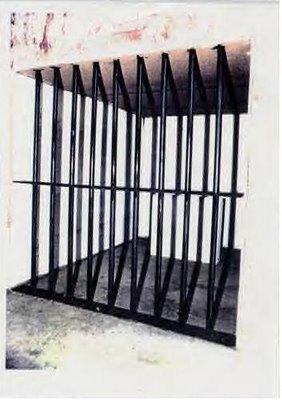
This picture of a prison cell known as "La Gaveta/The Drawer" corresponds to the Prison of Manzanillo, but a similar one exists at Combinado del Este. As a form of torture prison officials confine up to 15 political and non political prisoners for prolonged periods of time. It has been reported that prisoners are kept here for 8-10 months.  The small dimensions of the cell force prisoners to lie down all the time. Prisoners have to defecate and urinate in an extremely limited space and cannot stand up as the ceiling is very low.
Punishment cell or 'La Gaveta'

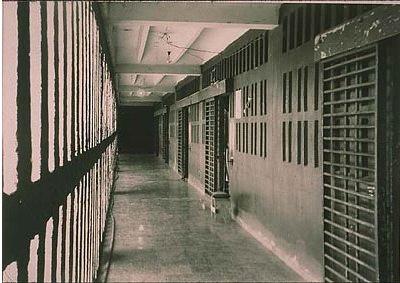
Isolation cells or 'Las Tapiadas/Blocked Cells in Combinado del Este Prison.
Replica of the confinement cell "Solitario" where opposition leader Dr. Oscar Elias Biscet was imprisoned at the Combinado del Este Prison  for nearly 8 years. Photo from Dr. Biscet's Blog
This torture is commonly known by prison guards in Cuba as 'La Shakira' A prisoner's hands and feet are tied down to his back. The prisoner is then thrown in a rodent infected cell and left there for 48 hours. The name of this torture uses the name of the Colombian singer as a form of mockery and denigration to the dignity of the prisoner who is forced to move his hips desperately in response to the painful position he is in.

Drawing of Dr. Biscet's cell at Combinado del Este. Photo from Dr. Biscet's Blog


Whereabouts of the Combinado del Este Prison: Kilometro 13 y medio y Carretera Monumental. Ciudad Habana, Cuba

Prison Layout: 3 Buildings known as 1, 2 and 3 with 4 floors (height) each. 

Political Prisoners: Political prisoners are confined within  a section of 'Building 1' 

Demographics: An estimate of 5,000 prisoners (Common and Political Prisoners).  


Food:  Unfit for human consumption:  30 grams of rice, 5 grams of a mixture from flour and soy ground beef, a watered/insipid pea soup. Every 15 days prisoners receive a small piece of chicken. 
 
Jail Cells: 3 meters in width, 6 meters in length, 2 meters in height. Usually in 1 cell there are 8 prisoners. 3 single-persons bed separated by 50 centimeters from each other. 

 Hygiene: Absence of the most basic hygiene is prevalent. Cells are infested with roaches, rats and mosquitoes. Roofs sealed with nylon on top to prevent bathroom residues from falling down. Water is scarce and not drinkable. Prison authorities do not provide disinfectants and prohibit prisoners' families from bringing them when they visit.

Overall:  Inhuman conditions as it has been reported and denounced by reports from political prisoners. 

Sources consulted:
Roy Walmsley, World Prison Population List, Eighth Edition (King College, London, December, 2009)
Reynol Vicente Sanchez, "Open Letter to Gerardo Hernandez Nordelo"
Juan O. Tamayo, "Cuban Inmates Complain of Poor Conditions" El Nuevo Herald (March 14, 2012)
Photos from 'El Combinado del Este Prison' extracted from section 'Carceles de Cuba' in forum Secretos de Cuba and Google Search 

Available Online Resources on Combinado del Este Prison:
Dugald McConnell and Brian Todd, "Cuban Prisoners said to Make Videos Exposing Prison Conditions" CNN (March 16, 2012) 
CBS4, Inside Cuba's Prison Walls (March 16, 2012)Reynol 
Oscar Elias Biscet,  To the New York Academy of Sciences (September 11, 2008). At the time Dr. Biscet wrote this letter he was confined to cell 1232, Building 1, Hall 2S at Combinado del Este Prison where he was imprisoned for 8 years.
Vicente Sanchez, "Open Letter to Gerardo Hernandez Nordelo"
Yamil Dominguez, Combinado del Este
Yoanis Sanchez, "A Visit to Cuba's Largest Prison" The Huffington Post (June 27, 2011)
Hiram Abí Cobas Nuñez, Combinado del Este: Una Carcel Pequeña Tras Otra Grande (Of Human Rights, 1991)
Inter-American Commission of Human Rights, Inter-American Yearbook on Human Rights, 1988
Armando Valladares, Against All Hopes: the Prison Memoirs of Armando Valladares (Ballantine Books, 1987)

Monday, April 30, 2012

HUMAN RIGHTS VIOLATIONS IN TURKEY

Turkish human rights activist, writer and publisher Ragip Zarkolu condemns serious freedom of speech violations in Turkey in this revealing letter that the he sent from the Selimiye Prison where he was held prisoner until last week:
"A friend of mine, who worked at the same publishing house as I did, had told me about the prison long before I was sent to it. Her husband had spent almost ten years there. This kind of prison establishments are called F. Tipi (Type F), in other words, they are prisons for criminals suspected of terrorism. In Turkey the notion of terrorism is fairly arbitrary; the existing political will and thus the state decides what is meant by terrorism. Merely to have once met somebody involved in so-called illegal political activity can be enough to make one suspect of similar ‘terrorist’ activities."
For the complete letter please refer to the The Dissident Blog, Turkey's freedom of speech is crumbling (Raqip Zarakolu Translation from Swedish: Jan Henrik Swahn)

Thursday, April 26, 2012

ESCAPE FROM CAMP 14


Escape from Camp 14 is a new book that provides an in-depth look at a North Korea, which in my view is the most totalitarian state of our times. It gives testimony of North Korea's harshest concentration camps (the so called Camp 14) through the eyes of Shin Dong Hyuk, a native of Kaetchon and the only living survivor of those camps. 


For further information on North Korea I refer you a photo gallery that I titled 'North of Totalitarianism'

Tuesday, April 24, 2012

PROFILE OF A COURAGEOUS MAN


What is his name? His name is Andrés Carrión Alvares. He is 38 years old, with a BA in Social Rehabilitation and a native of Santiago de Cuba.

What did he do? He dared to speak out and shouted 'FREEDOM FOR CUBA,' 'DOWN WITH THE DICTATORSHIP' 'DOWN WITH COMMUNISM' during Pope's Benedict XVI mass at the Antonio Maceo Square in Santiago de Cuba on March 26, 2012.

Consequences? He was detained and beaten by agents of the Cuban State Security. Up to this day Carrión is arrested in Santiago de Cuba pending trial. 


With his act of bravery, Carrión reminds the world of those like China's tankman, the anonymous hero who captured the world's attention when he stood up in font of a column of tanks to prevent the Chinese army from massacring protesters during the Tianamen Rebellion on June 5, 1989.
Note: Andrés Carrión was released today (April 23, 2012). It is significant to note that the pressure exerted by blogs, social networks (Twitter, Facebook) and other media outlets worldwide led the Castro regime to take this decision. Carrión's release is conditional. He will be on a police watch list and will be detained every time a public demonstration takes place in Cuba.

REFERENCES:
Top 3 photos of Andrés Carrión referred via Twitter from Aguaya Berlín
Photo of China's Tankman taken from China Digital Times 


Wednesday, November 9, 2011

DECREE 288: HOUSING LAW IN CUBA


One of the earliest promises of the Cuban Revolution was an immediate solution to the housing crisis as stated in Fidel Castro's platform during the
History Will Absolve Me speech. Indeed, forceful eviction of peasants or "desalojos" were presented in revolutionary propaganda as the quintessential image representative of the Batista regime. More than half a century later, lack of housing remains as the main social conflict that more than a million ordinary Cubans or 'Cubanos de a Pie.'

It is in this context and perhaps in response to a possible threat of a rebellion from bellow given the chronic lack of housing that affects Cubans that the government recently decreed a new ‘Housing Law’.This law has been praised in certain media outlets without proper analysis is mined with discrimination and an archaic definition of what constitutes property in Cuba. Under the new law, Cubans for the first time since the Castro regime conquered political power in January 1, 1959 will be allowed to buy and sell their houses. But as the saying goes “the devil is in the details.” The law of course does not occur in a vacuum or due to a government interest in the welfare of the people. One needs to understand that lack of housing is the main social issue that impacts most Cubans today and as such it has the potential for a popular explosion against the regime.


For example, Cubans who abandon the country can sell their properties or bequeath them to relatives, but they cannot keep their houses while living permanently in another country without a government permit. The state on the other hand investigates the “legitimate” origin of those who buy a house as a condition for the sale to go through or be prohibited. With a totalitarian regime controlling the politics and the economy of an entire society it is very difficult to prove the “legitimacy” (according with government definition) of your money. Only government officials can be benefited by measures of this type. The rest of society would have to find ways (as usual) to trick the government bureaucracy, bribe a few people in the process, and get what they want. The most questionable part of DECREE 288 is Article 110 that entrusts the Council of Ministries and its President ( Raúl Castro) with ample powers to decide over properties located in certain areas of the country. In other words, this means that the properties located in the best neighbourhoods (Vedado, Nuevo Vedado, Miramar, Siboney, Tarará, Varadero, etc) are reserved for the government elite.
Article 110: The Executive Committee of the Council of Ministries or his President can decide in reference to households located in certain areas of the country …. Source: Decree 288

There is of course the issue of ‘legitimacy’ in proving the origin of your money. In a totalitarian state where the government controls all political, cultural, social and economic activity how can anyone other than a limited number of state official of the highest rank, certain musicians and a bunch of professionals who travel and receive revenue in US dollars can prove that their money is legitimate? Certainly, this excludes the ordinary Cubans who receive remittances from relatives abroad but cannot prove the “authenticity” (according to state perceptions) of their money as the agency or networks they use is in most cases not connected with the Cuban government. The rest only leaves us with those that thrive under the ‘Illegal” economy and in Cuba the state deems illegal most economic activities.
Graphic Evidence that proofs how the Cuban government evicts people from their houses.
A family with 4 children, a pregnant mother in the province of Holguin, Cuba living on the side of the highway as the government evicted from their house with the excuse that "their houses were illegally constructed." Pictures from The Real Cuba (April, 2008). History repeats once again. The forceful eviction or "desalojos" that were harshly condemned in revolutionary propaganda, is now recurrent image in present day Cuba.
Prior to the issuing of Decree 288, there were other similar laws that equally gave the Cuban government ample powers over houses and even small villages settled in places the regime "deemed of interest."
For example this document is a copy of 'Notification of Forceful Expropriation' handed to Enrique Dominguez Gutierrez of Las Morlas, Varadero, Cuba by the corporation ALMEST a subsidiary of Cuba's Armed Forces. The document orders Dominguez and his family to abandon the location as it is of "state interest." Source: The Real Cuba January 16, 2008.
The Village of Las Morlas, Varadero, Cuba. January, 2008
A tractor demolishing Las Morlas
Police surveillance built in the entrance of this village to prevent former inhabitants of this location from entering again. Source The Real Cuba, January 16, 2008
REFERENCES:
Castro Internet Archive, History Will Absolve Me
Gaceta Oficial de Cuba, November 2, 2011: CE Decreto-Ley No. 288; BCC R. No. 85/11; INV RC. 01/11; Rs. Nos. 342, 343/11; MFP R. No. 351/11; MINJUS R. No. 270/11.
The Real Cuba
Wikipedia, Fulgencio Batista

Thursday, November 3, 2011

FORBIDDEN MUSIC IN THE USSR


Evidence shows that
totalitarian regimes approach certain type of music as a threat to power and ideology. It turns out that oppressive governments fear the effect certain music creates on the people and how this impacts the relationship between subordinates and those in power. Those of us who grew up in Cuba understand the meaning of music censorship as the Cuban government adopted a similar anachronistic mentality when censoring music throughout the past decades, from the Beatles to Porno para Ricardo. The author of this blog for example was reprimanded with a note on the 'Student File/Expediente Acumulativo' that pointed to 'ideological deviation/diversionismo ideologico for writing the name of rock bands in my class notebook.

Browsing through the web in search of similar blogs on totalitarianism I came across this
interesting post from a Blog titled 'The Weirdo's Dairy' by alias Fuzz (a.k.a Simona Jareckaite) from Birzai, Lithuania.

The post reproduces a 1985 document extracted from the Soviet archives that shows important evidence about music censorship in the former Soviet Union. The document compiles a list of musicians and groups that government representatives in the Nikolayev regional of Ukraine considered "harmful" to Soviet ideology. Eventually these ideological bureaucrats ordered the Konsomol (Communist Youth in the Soviet Union) to prohibit reproduction of this music in discotheques.

Translation of the document by Simona Jareckaite“Group Name and Type of Propaganda” - Extracts
For a complete list see:
Forbidden freedom: Rock music in the USSR and Soviet Lithuania
6. Kiss - neofascism, punk, violence
9. Iron Maiden - violence, religious obscurantism
10. Judas Priest - anticommunism, racism
11. AC/DC - neofascism, violence
13. Black Sabbath - violence, religious obscurantism
14. Alice Cooper - violence, vandalism
16. Scorpions - violence
19. Pink Floyd - distortion of Soviet foreign policy ("Soviet aggression in Afghanistan")
24. Donna Summer - eroticism
25. Tina Turner - sex
26. Junior English - sex
29. Ramones - punk
30. Van Halen - anti-Soviet propaganda
31. Julio Iglesias - neofascism
34. Village People - violence

For the complete 3 parts document please click this link to redirect your browser to the Weirdo's Dairy, Forbidden freedom: Rock music in the USSR and Soviet Lithuania