"Revolution is to Change Everything that Needs to Be Changed"
"Mister Imperialists: We have absolutely no fear of you" Reference: TuAventura
"50th Anniversary of the Revolution's Triumph" Reference: Prensa de Frente
"We Work: What about you? (Not working in Cuba carries a criminal conviction. Currently there is a large percentage of the population who refuse to work for the state with average salaries of $25 dollars a month). Reference: Prensa de Frente
"We want them to be like Che" (in reference to pioneers) Reference: TuAventura
Cuba
is a country of placards as long as they are pasted and sponsored by
the government for purposes of propaganda. Pro democracy signs are
immediately covered by the police and those responsible for their
content could face long prison sentences if they are caught. This
picture shows a police in Cuba covering a graffiti that reads "Down with Fidel" Reference: Enrique de la Osa / EFE / El Nuevo Herald
Who posts placards in Cuba?
The Propaganda branch of the Cuban Communist Party
What is their content?
As any form of propaganda, it is based on repetition of the same phrases. In this sense they make the Nazi precept that a repeated lie becomes true come to life. Usually placards praise Fidel and Raúl Castro. The most repeated slogans are "United We Will Triumph" "Victory After Victory" "Our Main Duty is to Perfect Socialism."
What is their purpose?
Physiological influence over the people. To present an image to foreign visitors that in Cuba everyone shares a common "revolutionary fervor."It is also an excuse for political organizations to look well with their superiors.
The above text is a translation taken from extracts of a larger article on placards in Cuba written by Eliecer Avila. For more information see Eliecer Avila, "El País de los Carteles" Diario de Cuba (15 de Mayo del 2012).
According with Reporters Without Borders, Human Rights Watch and other organizations that monitor human rights and freedoms worldwide, Eritrea, an extremely poor nation of the African continent in the neighborhood of Sudan, Ethiopia and Somalia is considered to be the most repressive nation on earth. A tough and in my view a controversial selection considering competitors in the repressive category such as North Korea, Cuba, Iran, Belarus and other nations. Under the regime of president Isaias Afewerki, 25% of Eritrea's population has fled over the past 20 years. The Afewerki regime has turned the nation into a "giant prison" according with Human Rights Watch with over 314 detention centers. Some of the country's prisons are underground, buried 229 feet bellow sea level with temperatures reported to reach 140 degrees Fahrenheit. In those prisons there are thousands of journalists, religious leaders and dissidents imprisoned, detained indefinitely and subjected to medieval tortures that include their feet shackled, tied to a cross or hung upside down and other forms of cruelty. Image from Edmund Sanders / TPN
For a complete report on jailed journalists see: Justin D. Martin, "Which Countries Jail the Most Journalists Per Capita? Taking the CPJ Data One Step Further" Columbia Journalism Review (April 2, 2012)
For more information on Eritrea see Joel Brinkley, "Eritrea, the most repressive nation on Earth" SFGate (April 29, 2012)
North Korea is the last Stalinist state on earth, and in 2006 it became
the latest country to join the nuclear club. Over the past two decades,
it has swung between confrontation and inch-by-inch conciliation with South Korea,
its neighbor, and the United States, in an oscillation that seems to be
driven both by its hard-to-fathom internal political strains and by an
apparent belief in brinksmanship as the most effective form of diplomacy.
Worldwide Ranking:Cuba has thefifth largest inmate population in the world with 531 prisoners for every 100,000 inhabitants.
Latin American Ranking:Cuba is ranked as the second nation with the largest inmate population per inhabitants in Latin America and the Caribbean.
Source Consulted: For statistical information on the number of prisoners per inhabitants in Cuba and worldwide see Roy Walmsley,World Prison Population List, Eighth Edition (King College, London, December, 2009), 1 & 3.
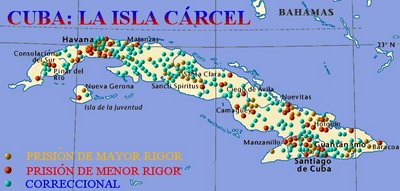
Cuba: The Prison Island Map of Cuba's Prisons. Legend from top to bottom: 1. Maximum Security Prisons. (Yellow) 2. Minimum Security Prisons. (Red) 3. Correctional/Reform Prisons.(Blue)
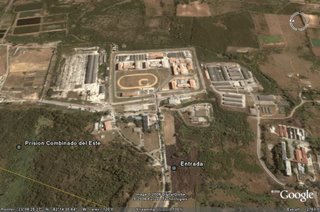
COMBINADO DEL ESTE PRISON Cuba's Largest Prison
Built in 1975.
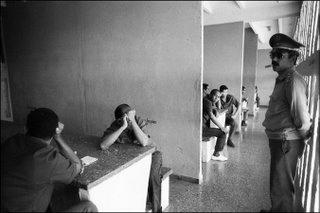
Hidden Camera inside El Combinado del Este Prison."En las Entrañas del Combinado del Este" by Dalvinder Singh Jagpal (inmate) and Dania Virgen García (independent journalist/reporter).
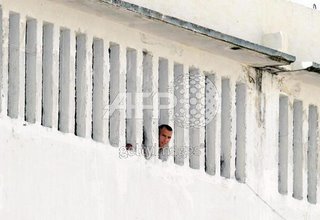
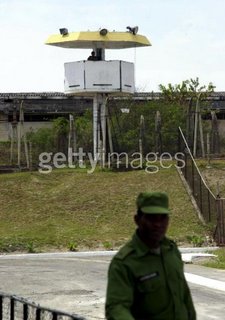
Aerial view of Combinado del Este
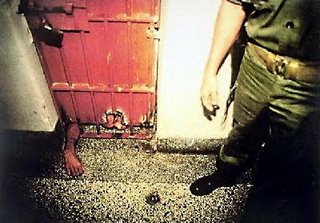
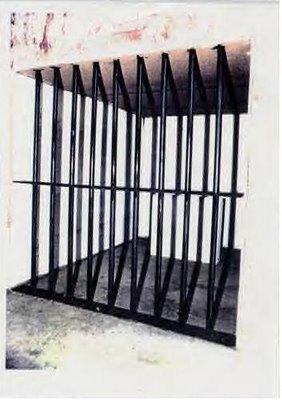
This picture of a prison cell known as "La Gaveta/The Drawer" corresponds to the Prison of Manzanillo, but a similar one exists at Combinado del Este. As a form of torture prison officials confine up to 15 political and non political prisoners for prolonged periods of time. It has been reported that prisoners are kept here for 8-10 months. The small dimensions of the cell force prisoners to lie down all the time. Prisoners have to defecate and urinate in an extremely limited space and cannot stand up as the ceiling is very low.
Punishment cell or 'La Gaveta'
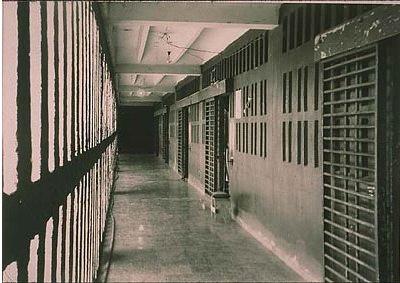
Isolation cells or 'Las Tapiadas/Blocked Cells in Combinado del Este Prison.
Replica of the confinement cell "Solitario" where opposition leader Dr. Oscar Elias Biscet was imprisoned at the Combinado del Este Prison for nearly 8 years. Photo from Dr. Biscet's Blog
This torture is commonly known by prison guards in Cuba as 'La Shakira' A prisoner's hands and feet are tied down to his back. The prisoner is then thrown in a rodent infected cell and left there for 48 hours. The name of this torture uses the name of the Colombian singer as a form of mockery and denigration to the dignity of the prisoner who is forced to move his hips desperately in response to the painful position he is in.
Drawing of Dr. Biscet's cell at Combinado del Este. Photo from Dr. Biscet's Blog
Whereabouts of the Combinado del Este Prison:Kilometro 13 y medio y Carretera Monumental. Ciudad Habana, Cuba
Prison Layout:3 Buildings known as 1, 2 and 3 with 4 floors (height) each.
Political Prisoners: Political prisoners are confined within a section of 'Building 1'
Demographics:An estimate of 5,000 prisoners (Common and Political Prisoners).
Food: Unfit for human consumption: 30 grams of rice, 5 grams of a mixture from flour and soy ground beef, a watered/insipid pea soup. Every 15 days prisoners receive a small piece of chicken.
Jail Cells: 3 meters in width, 6 meters in length, 2 meters in height.Usually in 1 cell there are 8 prisoners. 3 single-persons bed separated by 50 centimeters from each other.
Hygiene: Absence of the most basic hygiene is prevalent.Cells are infested with roaches, rats and mosquitoes. Roofs sealed with nylon on top to prevent bathroom residues from falling down. Water is scarce and not drinkable. Prison authorities do not provide disinfectants and prohibit prisoners' families from bringing them when they visit.
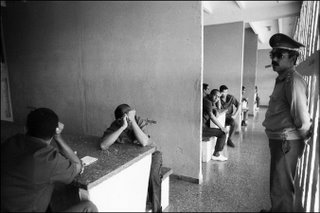
Overall: Inhuman conditions as it has been reported and denounced by reports from political prisoners.
Sources consulted: Roy Walmsley,World Prison Population List, Eighth Edition (King College, London, December, 2009)
Available Online Resources on Combinado del Este Prison:
Dugald McConnell and Brian Todd, "Cuban Prisoners said to Make Videos Exposing Prison Conditions" CNN (March 16, 2012) CBS4, Inside Cuba's Prison Walls(March 16, 2012)Reynol Oscar Elias Biscet, To the New York Academy of Sciences (September 11, 2008). At the time Dr. Biscet wrote this letter he was confined to cell 1232, Building 1, Hall 2S at Combinado del Este Prison where he was imprisoned for 8 years. Vicente Sanchez, "Open Letter to Gerardo Hernandez Nordelo"
Turkish human rights activist, writer and publisher Ragip Zarkolu condemns serious freedom of speech violations in Turkey in this revealing letter that the he sent from the Selimiye Prison where he was held prisoner until last week:
"A friend of mine, who worked at the same publishing house as I did, had
told me about the prison long before I was sent to it. Her husband had
spent almost ten years there. This kind of prison establishments are
called F. Tipi (Type F), in other words, they are prisons for criminals
suspected of terrorism. In Turkey the notion of terrorism is fairly
arbitrary; the existing political will and thus the state decides what
is meant by terrorism. Merely to have once met somebody involved in
so-called illegal political activity can be enough to make one suspect
of similar ‘terrorist’ activities."
For the complete letter please refer to the The Dissident Blog, Turkey's freedom of speech is crumbling (Raqip Zarakolu Translation from Swedish: Jan Henrik Swahn)
Escape from Camp 14 is a new book that provides an in-depth look at a North Korea, which in my view is the most totalitarian state of our times. It gives testimony of North Korea's harshest concentration
camps (the so called Camp 14) through the eyes of Shin Dong Hyuk, a native of Kaetchon
and the only living survivor of those camps.
For further information on North Korea I refer you a photo gallery that I titled 'North of Totalitarianism'
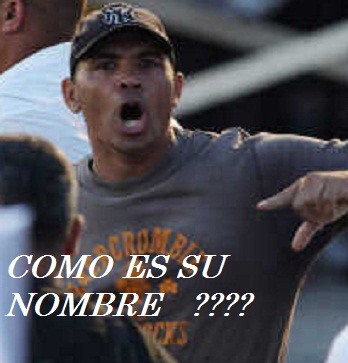
What is his name? His name is Andrés Carrión Alvares. He is 38 years old, with a BA in Social Rehabilitation and a native of Santiago de Cuba.
What did he do? He dared to speak out and shouted 'FREEDOM FOR CUBA,' 'DOWN WITH THE DICTATORSHIP' 'DOWN WITH COMMUNISM' during Pope's Benedict XVI mass at the Antonio Maceo Square in Santiago de Cuba on March 26, 2012.
Consequences? He was detained and beaten by agents of the Cuban State Security. Up to this day Carrión is arrested in Santiago de Cuba pending trial.
With his act of bravery, Carrión reminds the world of those like China's tankman, the anonymous hero who captured the world's attention when he stood up in font of a column of tanks to prevent the Chinese army from massacring protesters during the Tianamen Rebellion on June 5, 1989.
Note: Andrés Carrión was released today (April 23, 2012). It is significant to note that the pressure exerted by blogs, social networks (Twitter, Facebook) and other media outlets worldwide led the Castro regime to take this decision. Carrión's release is conditional. He will be on a police watch list and will be detained every time a public demonstration takes place in Cuba.
REFERENCES:
Top 3 photos of Andrés Carrión referred via Twitter from Aguaya Berlín